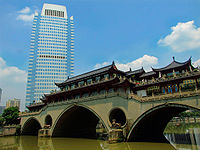

Attractions around Kangding

Namo Lamasery
It is the most active lamasery in the area with around 80 lamas in residence. Set in the west of town on the northern bank of the river, it affords good views of Kangding and the valley. Walk south along the main road, following its bend to the left for 2 km. Cross the bridge at the southern end of town and continue on 300 m. Next to a walled Han Chinese cemetery is a dirt path that follows a stream uphill to the lamasery.
History of Namo Lamasery
It was built on Mountain Poma in 867 by Sangdrivintsing, Dignitary of Nyingmapa and was named "Namzer" after its site. Later, since Yund-engrangbu inherited the religion of Kadampa from Xiarewa, who was the successor of Atiisa Dignitary, Tibet, Namzer changed to believe in Kadampa. At that time, the Lamasery was famous for its strict discipline. In 1279, Kublai Khan, the first Emperor of Yuan Dynasty, called in Marenyixidoki Dignitary of Namzer. Kublai Khan spoke highly of Namzer and invited Marenyixidoki Dignitary to teach and spread Buddhism inland. The Lamasery was burned into ruin by Mogolian troops in 1639 and was rebuilt in 1646 by Jangyanghenju on the "Hill Ru" opposite Namzer.
You can also visit Anjue Lamasery which is a fairly quiet temple with several monks and a few old prayer wheels. The temple is located behind Gonggashan Lushe.
Tagong
About 110 km northwest of Kangding lie the Tagong Grassland, a vast expanse of green meadow surrounded by snow-capped peaks and dotted with Tibetan herdsmen and tents. An annual horse racing festival features thousands of local Tibetan herdsmen and Tibetan opera.
The small village of Tagong is a fantastic place to visit if you want to get a taste of Sichuan's Tibetan Wild West. In the village, Tagong Lamasery
5blends Han Chinese and Tibetan styles and dates back to the Qing Dynasty.
A 15-yuan bus ride from Kangding City (Dartsendo) gets you to Tagong (Lhagang) which is a very wild-west kind of Khampa town with a sacred mountain, a college of Buddhism (the largest in Sichuan) and a huge Sakyapa monastery. At the college you might run into a Hong Kong Chinese who is studying here and knows a lot about the area. Tagong's facilities are primitive--forget about hot showers. There is a guest house in the government compound on the west side of the highway in the town's center. Dorje Tashi Rinpoche runs a model orphanage nearby; they are glad for visitors; to find it, look for a new, ornate gate leading into a compound with a tall new building on the right side. If you planned ahead and picked up a few toys or kid's books in Kangding, they will be thrilled to receive them.
From Tagong town there are trails heading off in various directions to different pasture lands. Circumambulation of Zhara Mountain takes somewhere between 10 and 30 days, depending on who you ask. One can trek from here to Mo Ge Tso (a lake north of Kangding City) in probably two days--they are planning to put a road through, so trek now while you still can.
Mugecuo Lake
There are several mountain lakes and hot springs in the vicinity of Kangding. Lying 21 km to the north of town up the Yala Valley, Mugecuo Lake is one of the highest lakes in northwestern Sichuan, at 3700 m. Local also boast that it's one of the most beautiful lakes. Trails around the lake lead to other smaller lakes such as the Red Sea and Seven Color Lake.
Mo Ge Tso Lake is such a popular destination that they have made the area into a park, complete with ticket sellers at the entrance. That said, it's still worth it. Don't stop at the lower lake (where the crowds are) but keep on going to the upper lake, which has beautiful sand bars and pristine scenery. There are now public buses to Mo Ge Tso, or you could hire a taxi. If the road connecting the lower and upper lakes is in bad shape, you will need to walk about an hour and a half. There is a very lovely hotspring pond between them--not so good for bathing but the waters of two springs are said to be good for the stomach and eyes respectively. From Mo Ge Tso you can trek 1-2 days past the south flank of Zhara Latse mountain to Tagong.
About 30 minutes by bus uphill from Kangding City is a hamlet called Zeduo Tang . From here starts a very well-used trail that crosses the river and heads up a valley toward some snowy mountains. According to Andre Migot, who traveled this way in 1947, this trail is the old caravan trail by which all traffic headed out of Kangding before the highway existed. It starts by some
farmhouses about 500 meters of switchbacks past the place where you see a Zeduo Tang signboard by the side of the highway. Theoretically you could walk all the way across Kham from here. One nice 2-3 day hike that starts here goes to Jiagenba. When you get back there are some seedy hotspring baths at Zeduo Tang, and a couple of small restaurants. The baths are not as nice as those in Kangding City at Erdaoqiao, but make a nice finish to a long hike.
Elsewhere in Kangding County is Hailougou --a glacier park at the foot of Gongga Shan that's very popular with Chinese tourists. It makes a great starting point for treks in the Gongga Shan region.
For the really adventurous, you can try to get to Kazhi Gonpa (Gao'er Si in Chinese). This is a collection of 200-year-old stone buildings deep in a valley with about 100 monks, Sakyapa. To get there, take the bus toward Yajiang. The bus takes about four hours to go over Tsedo La, pass through the town of Xinduqiao, and climb through forest to another pass. Just at the pass, look for a dirt road leaving the main highway going left. Get off the bus here. A little ways in on this dirt road you will have a spectacular view of Gongga Shan--IF the weather is clear. Walk about 1 km to Kazhi Monastery, which is only just barely in Kangding County. The monks will be utterly amazed to see you. Bring some food and compensate for lodging with a cash donation to the monastery.


+86 20 22822049