
Choose languange China Travel Guide and China tour packagesChina Travel Guide China Travel Guide and China tour packagesvieje a china China Travel Guide and China tour packagesGiro giusto della Cina China Travel Guide and China tour packagesExcurs?o justa de China China Travel Guide and China tour packagesVoyage en Chine, Chine Excursions  China Travel Guide and China tour packageschina reisen China Travel Guide and China tour packages
China Travel Guide and China tour packages
Call us from USA: 415-287-0878
Home  |  China tours  |  Yangtze Cruise  |  City guide  |  China flight  |  China hotels  |  Travel tools 

Find a tour

Classic China Tours
Native Ethnic Visit
Three Gorges Cruise
Bike and Trek Adventure
City Tours
Cultural activities
Destinations:
Beijing
Shanghai
Hong Kong
Xian
Lhasa
Hangzhou
Suzhou
Guilin
Chengdu
Urumqi
Zhaoxing
Guangzhou

Testimonial

Hot Attractions
Lijiang
Hutiao Gorge
Dali
Kunming
Zhongdian
Mount Meili
Xishuangbanna
Festivals
Calendars
Bai Ethnic
Mosuo Ethnic
Naxi Ethnic
Yi Ethnic
Dai Ethnic
Yunnan Travel Guide
1 2 3 4

Home : China Guide : Yunnan : Bai Ethnic in Dali

Bai Ethnic in Dali Bai Ethnic in Dali
Of the 1,858,063 Bai people, 80 percent live in concentrated communities in the Dali Bai Autonomous Prefecture in Yunnan Province , southwest China . The rest are scattered in Xichang and Bijie in neighboring Sichuan and Guizhou provinces respectively.

The Bais speak a language related to the Yi branch of the Tibetan-Myanmese group of the Chinese-Tibetan language family. The language contains a large number of Chinese words due to the Bais' long contact with the majority Chinese ethnic group C Han.

Situated on the Yunnan-Guizhou Plateau, the Bai area is crisscrossed with rivers, of which the major ones are the Lancang, the Nujiang and the Jinsha. The river valleys, dense forests and vast tracts of land form a beautiful landscape and provide an abundance of crops and fruits. The area around Lake Erhai in the autonomous prefecture is blessed with a mild climate and fertile land yielding two crops a year. Here, the main crops are rice, winter wheat, beans, millet, cotton, rape, sugar-cane and tobacco. The forests have valuable stocks of timber, herbs of medicinal value and rare animals. Mt. Diancang by Lake Erhai contains a rich deposit of the famous Yunnan marble, which is basically pure white with veins of red, light blue, green and milky yellow. It is treasured as building material as well as for carving.

The Third Month Fair in DaliCulture and folklore
Over the centuries, the Bais have created a science and culture of their own. Agriculture was dominant in the Erhai area as early as the Neolithic Age. People then knew how to dig ditches for irrigation. During the Nanzhao regime, they began the cultivation of rice, wheat, broomcorn, millet and several other crops, and built the Cangshan water-conservancy project which could bring water to tens of thousands of hectares of land. To their credit are inventions and advances in meteorology, astronomy, calendar, architecture, medical science, literature, music, dancing, carving and painting. Among the representative works of the Bai people are Transit Star Catalogue for Time Determination by the Ming Dynasty scholar Zhou Silian, Collection of Secret Prescriptions by Chen Dongtian and Tested Prescriptions by Li Xingwei. These classics recorded and summarized in detail the valuable experience of the Bai people in astronomy and medicine.

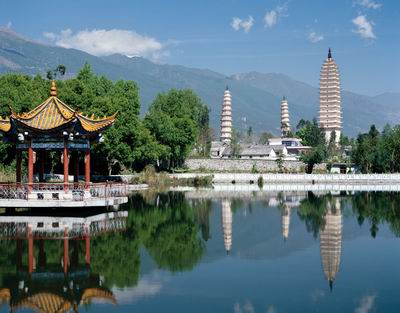
Old town of DaliThe superb architectural skill of the Bai people is represented by the three pagodas at the Chongsheng Temple in Dali. Built during the Tang Dynasty, the 16-storey main tower is 60 meters high and still stands erect after more than 1,000 years. It bears a resemblance to the Dayan Pagoda (Wild Goose) in Xi'an , an ancient Chinese capital city in today's Shaanxi Province . Figurines in the Shibaoshan Grottoes in Jianchuan County are lifelike, possessing both the common features of figure creation in China and the unique features of the Bai artists. The architectural group in the Jizushan Temple , with bow-shaped crossbeams, bracket-inserted columns, and gargoyles representing people, flowers and birds created with the open carving method, shows the excellent workmanship of the Bai people. The Bais also have high attainments in lacquerware.

They have created a wealth of literary works reflecting their life, work, and struggles against nature and oppression. The epic, Genesis , sings the praises of the communal life of Bai primitive society. Some poems by Bai poets have been included in the Complete Poems of Tang Dynasty . The History of the Bais , Anecdotes of Nanzhao and Kingdoms of Southwest China are among the best historical works written by Bai historians. They provide important data for the study of the history of the Erhai area.

The Bai people are good singers and dancers. The "Lion Dance," created during the Nanzhao regime, was appreciated in the central plains during the Tang Dynasty. Bai opera, known as chuichui , is an art form combining folk music and dancing. It has also absorbed some of the characteristics of Han operas.

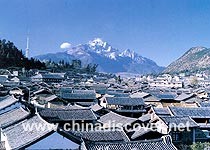
Old town of DaliThe famous painting depicting the Resurgence of the Nanzhao was created in AD 899 by Bai painters Zhang Shun and Wang Fengzong. This masterpiece was stolen by foreign imperialists in 900 from Beijing .

Customs and habits
The Bais are Buddhists and worshippers of "communal god." Dotted with monasteries and temples, Dali has been known as a "Scented Wonderland." Abbots who held huge amount of land and other property in the past were big landlords and usurers. The ordinary people were heavily burdened by this caste and by religious activities which required sacrifices of cattle and other valuables.

Monogamous families have been the basic social cells of the Bais, with a very few people who practiced polygamy. Parents live with their unmarried children, but only in big landlord families did four generations live together. Before the founding of the People's Republic of China in 1949, matches between young men and young women of the same surname or clan were not permitted, while marriages between cousins were encouraged, and were arranged by the parents. High bride prices caused many poor families to fall into debt. Women were discriminated against, and only men had the right to inherit family property. But all such feudal practices and customs have been fading away since 1949. Young people now enjoy the freedom to choose their lovers.

   9 days Kunming, Dali, Lijiang, Zhongdian

Yunnan Tour Packages Page 1  2  3
Attractions in Dali
Bai Ethic Culture
Butterflies Spring
Cangshan Mountain
Dali Marble
Erhai Lake
Festivals of Sanyuejie
Jizhu Mountain
Pagodas of Chongsheng
Streets in old town
Tie - Dyed Cloth
Torch Festivals
Xizhou Market
Zhonghe Temple
Dali Travel Guide
About Dali
Map of Dali
What to see
History of Dali
Dali Weather
Dali Tours
Dali Photos
Dali Hotels
Quick Search
 Try Any word  
Need more informations?
Mr.   Mrs.   Miss
Name
Email
Message
Remark: If you like any tour package, please tell us the tour code.
  
Home | Payment | About us | Contact us | Terms | Customer's Comment | Links | Dali Travel Tips
The Bais are Buddhists and worshippers of "communal god." Dotted with monasteries and temples, Dali has been known as a "Scented Wonderland." ...blog

The following websites are also running by HRC Sinoway Travel

Expert in Dali travel services, Dali tours, Dali bike tours, Yangtze River cruise, Dali festivals, Dali trekking tour, Dali Minority Ethnic Culture tours. Copyright © 2004 Sinowaytravel.com™ All rights reserved.

China Travel China Tour Beijing Tour Shanghai Tour Guangzhou Hotel China Vacation Hong Kong Hotel Book China Hotel Canton Fair Business Yangshuo holiday Vietnam Tours