

Yunnan Tourism

-
Province :Yunnan (Chinese: 云南, Pinyin:yunnan)
-
Population :44,830,000
-
Area :394,100 square km (152,200 square mile)
-
Overview:Ethnic minorities in Yunnan account for about 34 percent of its total population. Major ethnic groups include Yi, Bai, Hani, Zhuang, Dai and Miao.
Yunnan, province in southern China, bordering the countries of Myanmar, Laos, and Vietnam. Most of the inhabitants of Yunnan live on a relatively low plateau in the east, which includes Kunming the capital, largest city, and principal industrial center of Yunnan. An inaccessible high plateau, dissected by deep gorges, dominates the western areas.
In Yunnan, there is a lot of natural scene. The places of interest here are Dian Spring, Cang Mountain in Dali, Xishuangbanna and so on.
Ethnic minorities, includingYi, Miao, Dai, and Tibetans, constitute about a quarter of the total population. The chief crops, restricted to small areas suitable for farming, are rice and corn. Resources include tin ( at Gejiu), copper ( at Dongchuan), iron are ( at Wuding), and coal ( underlying much of the province).
There are 16 sub-provincial regions in Yunnan, including 3 cities: Kunming, Qujing and Yuxi;
8 autonomous prefectures; Dali Bai Autonomous Prefecture, Honghe Hani-Yi Autonomous Prefecture, Dehong Dai-Jingpo Autonomous Prefecture, Chuxiong Yi Autonomous Prefecture, Wenshan Zhuang-Miao Autonomous Prefecture, Nujiang Lisu Autonomous Prefecture and Diqing Zang Autonomous Prefecture;
And 5 other prefectures: Simao ( with the largest size in land area), Zhaotong, Baoshan, Lijiang and Lincang. There prefectures are sub-divided into 128 countries/districts, including 7 districts attached to Kunming, Qujing, and Yuxi, 12 country-level cities, 29 autonomous countries for ethnic minorities and 80 other countries.
Places to go in Yunnan
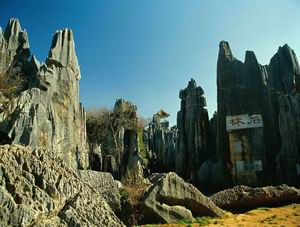
kunming is known to visitors from home and abroad as the Spring City. The most famous attracion in Kunming is the Stone Forest...more
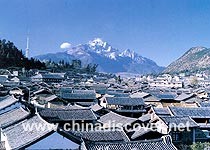
The old town of Lijiang has a history more than 800 years and was once a confluence for trade along the old tea horse road. The trekking in Tiger Leaping Gorge is something worth to try...more
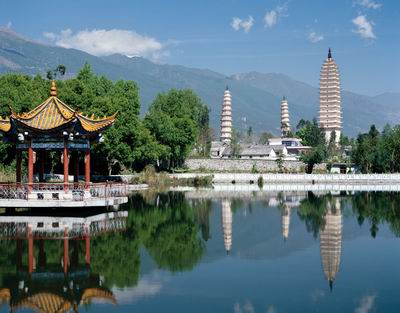
Dali is the ancient capital of both the Bai kingdom Nanzhao, which flourished in the area during the 8th and 9th centuries....more
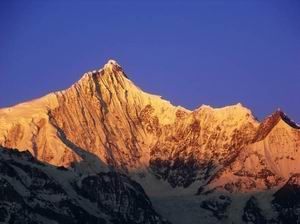
Located in the northwestern part of Yunnan, it is the Tibetan inhabited areas. Famous for the Meili Snow Mountain, Tibetan town of Zhongdian and the ancient Tea-horse road to Tibet...more