

Hani Ethnic in Honghe

Rice Terraces, Yuanyang
  • Province :
    Yunnan (Chinese: 云南, Pinyin:yunnan)
  • Population :
    44,830,000
  • Area :
    394,100 square km (152,200 square mile)
  • Overview:
    Ethnic minorities in Yunnan account for about 34 percent of its total population. Major ethnic groups include Yi, Bai, Hani, Zhuang, Dai and Miao.

The Honghe Hani-Yi Autonomous Prefecture, which includes Honghe, Yuanyang, Luchun and Jinping counties. Others dwell in Mojiang, Jiangcheng, Pu'er, Lancang and Zhenyuan counties in Simao Prefecture; in Honghe's Menghai, Jinghong and Mengla counties; in Yuanjiang and Xinping, Yuxi Prefecture, and (a small number) in Eshan, Jianshui, Jingdong and Jinggu counties.


Their language belongs to the Yi branch of the Tibetan-Myanmese language group of the Chinese-Tibetan language family. Having no script of their own before 1949, they kept records by carving notches on sticks. In 1957 the people's government helped them to create a script based on the Roman alphabet.


The areas inhabited by the Hanis have rich natural resources. Beneath the ground are deposits of tin, copper, iron, nickel and other minerals. Growing on the rolling Ailao Mountains are pine, cypress, palm, tung oil and camphor trees, and the forests abound in animals such as tigers, leopards, bears, monkeys, peacocks, parrots and pheasants. Being subtropical, the land is fertile and the rainfall plentiful C ideal for growing rice, millet, cotton, peanuts, indigo and tea. Honghe's Nanru Hills are one of the country's major producers of the famous Pu'er tea.


The Hanis are monogamous. Before 1949, a man was allowed to have a concubine if the wife had born him no son after some years of marriage. However, he was not supposed to forsake his original wife to remarry. Marriages are mostly arranged by the parents.

Hani (Akha) Culture in Yunnan, China (Click to see details)The Hanis in Mojiang and Biyue have a very interesting custom for settling an engagement. The parents of both the girl and boy involved should walk some distance together, and so long as they meet no animals the engagement can go ahead.


The brides usually return to live with their parents only two or three days after the wedding ceremony and join their husbands again at rice-transplanting time. But this is not practiced in the Honghe area.


A son's name begins with the last one or two words of his father's name in order to keep the family line going. This practice has been handed down for as many as 55 generations in some families.


The Hanis prefer clothing made of home-spun dark blue cloth. Men wear front-buttoned jackets and trousers, and black or white cloth turbans. Women have collarless, front-buttoned blouses with the cuffs and trouser legs laced. Hanis in Honghe wear jackets buttoned on the right side and decorated with silver ornaments. They wear black turbans. Women there, as well as in the Lancang area, wear skirts, round caps, and strings of silver ornaments. Both men and women wear leggings. In Mojiang, Yuanjiang and Jiangcheng, some women wear long, pleated or narrow skirts, while others have knee-length trousers with embroidered girdles. Women in general like to wear earrings, silver rings and necklaces. Married and unmarried women wear different hairstyles.


The Hanis build their two- and three-story houses of bamboo, mud, stone and wood on hill slopes. A village comprises from ten to as many as 400 households. In places like Honghe, Yuanyang and Luchun, houses have mud walls and thatched roofs, supported by wooden pillars placed on stone foundations, while in Honghe, houses are built of bamboo.


Hani (Akha) Culture in Yunnan, China (Click to see details)They are polytheists and ancestor worshippers. Rituals are regularly held to worship the Gods of Heaven, Earth, the Dragon Tree and their village, as well as their family patron gods. Believing they are protected by the God of the village gate, the Hanis in Honghe also hold ceremonies to pay respects to this deity. A shaman presides over the rites, at which sacrifices of cattle are offered.


There are days devoted to animals, such as Sheep Day, on which sacrifices are made. On days when someone dies, a wild animal comes into the village, a dog climbs onto the roof of a house, or a fire breaks out, people would be called to stop working and hold ceremonies to avert misfortune.


The Hani people celebrate their New Year in October, as their lunar calendar begins in that month. During the weeklong festivities, pigs are slaughtered and special glutinous rice balls are prepared. Relatives and friends visit each other, go-betweens are busy making matches, and married women go to see their parents. They also celebrate the June Festival, which falls on the 24th of that month. This is a happy occasion especially for the young people. They sing, dance, play on swings and hold wrestling contests. At night, people in some places light pine torches while beating drums and gongs to expel evil spirits and disease. Like their Han neighbors, the Hanis who live in the Honghe area celebrate the Spring, Dragon Boat and Moon festivals.

Legends, fairy tales, poetry, stories, fables, ballads, proverbs, mythology and riddles form their oral literature. Genesis is a legend describing the origin of all things on earth. An Account of Floods tells how men conquered floods. Labare and Ahjigu are songs sung on solemn occasions such as weddings, funerals, festivals and religious rituals.


The Hanis are good singers and dancers. They use three- and four-stringed instruments, flutes and gourd-shaped wind instruments. Popular are the "Hand Clapping" and "Fan" dances. The "Dongpocuo" dance popular in Honghe is a typical Hani dance; it is vigorous, graceful and rhythmic.

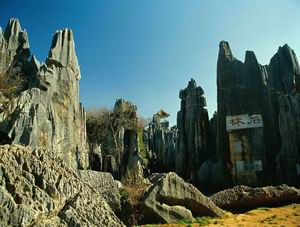
Stone Forest
The Stone Forest Scenic Area is located in Shilin County, 89 kilometers from Kunming. The area, covering 350 square kilometers, is the highest karst terrain in the world and a national scenic area in China.
more
Western Hill
Western Hill - The forest reserve on the west bank of the Dianchi lake consists of the Huating, Taihan mountains, which extend for more than 40 kilometres.
more